“A house is built with bricks, but a home is built with stories.”
– Anonymous
In India, a wall has never been just a wall. Long before designers spoke of accent surfaces and feature walls, families in Mithila, Maharashtra, Rajasthan and Madhya Pradesh were already turning bare mud and cloth into storytelling canvases. That tradition, today known as Indian folk art, is quietly finding its way back into how we imagine our living spaces.
As someone who spends his days thinking about buildings, I have always believed that structure gives a home its shape, but art gives it a soul. This is a perspective that Pujit Aggarwal often returns to: the best spaces are not just designed, they are lived in, remembered and felt.
So let us look at four remarkable traditions from the folk art of India and what they bring to modern homes.
Why Folk Art, Why Now?
For years, Indian interior design leaned towards imported minimalism: neutral palettes, clean lines and very little personality. The pendulum is now swinging back. Homeowners want spaces that feel rooted and warm, and that carry a story, even in a compact apartment.
Folk art does exactly that. It brings craft, colour and meaning into spaces that might otherwise feel generic, and it supports the artisans who have kept these traditions alive for generations.
Madhubani: The Soul of Mithila
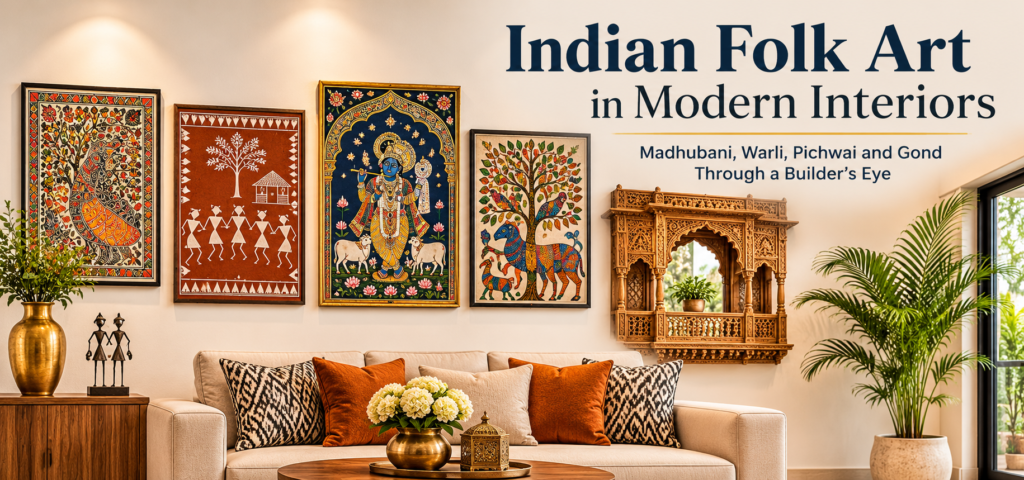
Born in the Mithila region of Bihar, Madhubani began as wall art created for festivals and weddings. Its fine linework, intricate patterns and motifs of fish, lotus, peacocks and the sun make it instantly recognisable.
In a modern home, a Madhubani panel works beautifully in a living room or entrance foyer. Its detail rewards a closer look, which makes it a lovely conversation starter. For anyone exploring Indian home decor, it is perhaps the most graceful place to begin.
Warli: Simplicity That Speaks
Created by the Warli community of Maharashtra, Warli art uses basic shapes (circles, triangles and squares) to depict daily life, harvests, dance and community. Traditionally painted in white on earthy mud walls, its power lies in restraint.
That is precisely why it suits contemporary interiors so well. A Warli mural on a dining wall or staircase adds rhythm without clutter. It proves that a design can be simple and still deeply meaningful.
Pichwai: Devotion in Detail
Rooted in Nathdwara, Rajasthan, Pichwai paintings were traditionally hung behind the idol of Shrinathji. Rich in lotus motifs, cows and scenes from Krishna’s life, they are celebrated for their depth of colour and sheer craftsmanship.
In today’s homes, a Pichwai piece brings a sense of calm and grandeur. It sits well in a prayer corner, a study or a formal sitting area, and adds an almost regal warmth to the room.
Gond: Where Nature Comes Alive
Among the most loved forms of tribal art, Gond art comes from the Gond community of central India, especially Madhya Pradesh. Every Gond painting is built from dots, dashes and flowing lines that give trees, birds and animals a sense of movement and spirit. For the Gond people, art is closely tied to belief, and every creature carries a story.
Colourful and playful, a Gond piece is a wonderful choice for a bedroom, a child’s room or a reading nook. If you are curious about tribal art painting for your home, this is a vibrant starting point.
Jharokha: Traditional Architecture Meets Artistic Elegance
Inspired by the traditional architectural features of Rajasthan and Gujarat, a Jharokha is an ornate overhanging balcony or window that was once a defining element of royal havelis and palaces. Known for its carved wooden frames, intricate detailing and decorative arches, Jharokhas reflect India’s rich architectural craftsmanship.
In modern interiors, Jharokha-inspired designs can add a touch of heritage and elegance to living rooms, entrance walls and courtyards. Whether used as a decorative wall frame, an antique-style mirror or an architectural feature, it creates a beautiful connection between traditional Indian design and contemporary living. For anyone looking to bring traditional Indian art and decor into their home, Jharokha-inspired elements offer a timeless choice.
Bringing Folk Art Home: A Builder’s Perspective
From where I stand, there are a few thoughtful ways to bring art into a space:
- Plan the wall early. Decide which walls will hold art while the space is still being designed, so lighting and proportions support it.
- Let one piece lead. A single statement piece often works better than many competing ones.
- Mix old with new. Folk art pairs beautifully with modern furniture, natural textures and soft lighting.
- Buy with intent. Choose authentic pieces directly from artisans where possible, so the value reaches those who created it.
The Larger Picture
Real estate is often measured in square feet, but a home is measured in feeling. When we choose Indian folk art for our interiors, we are not simply decorating. We are carrying forward a legacy and giving a community of artists a place on our walls and in our lives.
Because when a space reflects where we come from, it becomes more than a structure. It becomes a home.